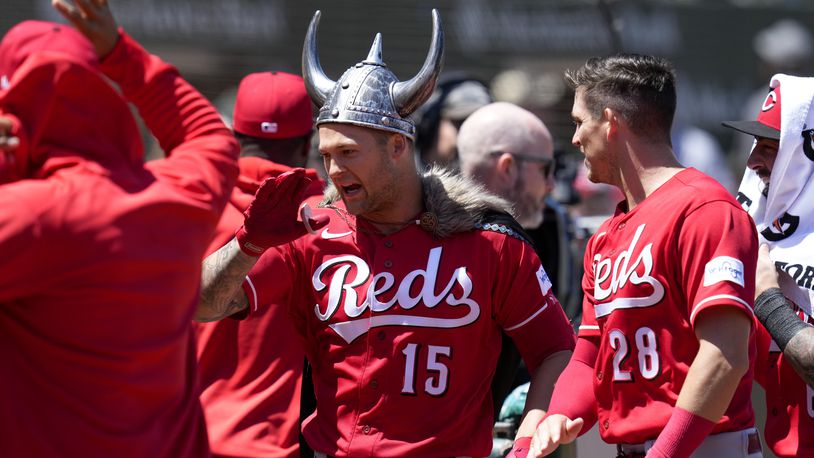
There’s an old saying that time is of the essence. That saying applies to the Cincinnati Reds in a few ways this season.
The pitch clock is one way time is affecting the Reds. Pitch clock violations haven’t drastically cost the Reds in games. The pitch clock is doing what Major League Baseball wants early on. According to a report from Front Office Sports reporter Michael McCarthy. The average MLB game is 29 minutes shorter compared to this time last year.
Major League Baseball isn’t the only sports organization concerned about time. The NCAA is striving to shorten the length of college football games. If one found baseball games to be long prior to the pitch clock. Many college football games hover around three-and-a-half hours. The NCAA plans to implement three time-related rule changes next season.
MLB and college football are striving for the same goal. To boost the public’s interest in their games. In an era where there are a billion things rivaling them for attention. The pitch clock might be helping MLB attendance-wise. Major League Baseball’s average attendance was averaging 26,753 fans as of April 26. Reportedly up five percent compared to late April last year. The pitch clock doesn’t appear to be providing a boost to the Cincinnati Reds’ attendance.
The Reds are averaging 15,515 fans per home game through May 4th. Down roughly 1,000 fans compared to that date last year. Cincinnati’s average attendance is not the worst in the National League. The Pittsburgh Pirates and Miami Marlins have worse average attendance than the Reds. The Oakland Athletics have the worst attendance so far in MLB.
Attendance early in the season is affected by many things. The school year is one major factor. Even if the Reds consistently had a winning record in April. Getting many fans to the ballpark on a school night would be a challenge. As the Reds have showcased over time; a team’s performance is another major factor.
Fortunately for the Reds, there are signs of improvement on the field. Which could provide a boost to the Reds attendance if those improvements continue. Cincinnati has a 13-18 record heading into May 5th. They were 3-21 heading into that date last year. There’s one major reason for the Reds improved record compared to last year. Cincinnati’s penchant for winning games fueled by late game rallies. The Reds won several games in the last two weeks with late game rallies.
Cincinnati beat the San Diego Padres last Tuesday in extra innings. The Reds beat Oakland last Saturday with a ninth inning rally. Featuring a Jake Fraley broken bat double to take the lead. The Reds also won back-to-back 7-6 games over the Texas Rangers. Then swept Texas with a walk-off homer from Nick Senzel. Part of a big and healthy week for Senzel. A welcome sight for Reds fans given his recent injury struggles.
The Reds’ late game rallies are a welcome sight for fans beyond the winning results. Those rallies stand in contrast to the Reds bullpen. Which could be described as shaky at best. Cincinnati’s relief pitchers continue to be a sore spot. Along with their coaching staff’s bullpen management strategy.
Time is also of the essence for Reds TV partner Bally Sports Ohio. BSO’s owners Diamond Sports Group made a late payment this week. To the Reds in order to maintain their broadcasting rights. Amid financial uncertainty surrounding Bally Sports’ regional networks. Perhaps the payment was a sign that Bally Sports feels it needs the Reds. More than the Reds feel it needs Bally Sports Ohio. Given the contingency plans MLB and the Reds put forward to broadcast games in BSO’s absence.
When it comes to the Reds, another phrase about time applies. That phrase being better late than never. Late innings are proving to be pivotal for the Reds. While the team is getting their TV rights payments late but still getting them.

 Cincy Sports Journal
Leave a comment