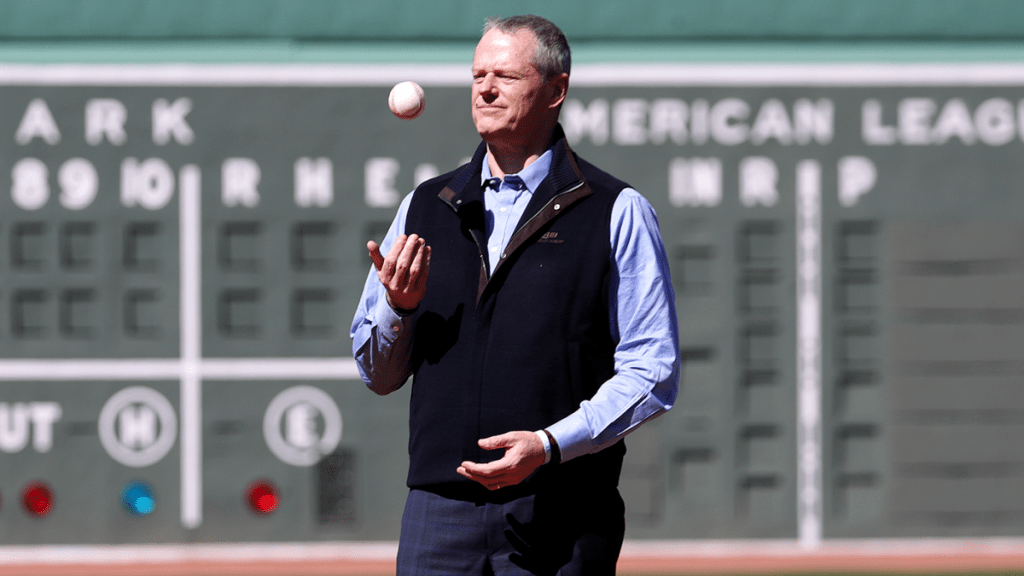
The NCAA is heading into its showcase event with their new president Charlie Baker. At a time where the NCAA’s status quo has been upended.
Charlie Baker is taking on what could be considered one of the most thankless jobs in American sports. He’s now in the middle of his first month as the NCAA’s President. Formally succeeding Mark Emmert on March 1st. Baker takes on this role as the NCAA heads into March Madness. With the NCAA Men’s and Women’s Basketball Championships set to tip off next week.
Baker heads into this role after two terms as the Governor of Massachusetts. The NCAA seems hopeful that his political experience will come in handy. As the organization lobbies for Congress to do things the NCAA won’t do on its own. Mainly, setting up a national standard to regulate name, image and likeness (NIL) compensation deals. Those deals represent a major shift for college athletics.
Baker’s consensus building skills could be what the NCAA needs at this moment. He was a relatively well-regarded Republican governor in predominantly Democratic Massachusetts. What made him electable in Massachusetts might help him in Washington D.C. Baker is not the type of Republican regularly featured on the FOX News Channel. The last thing the NCAA needs at this moment is a polarizing person as their president. Baker’s moderate reputation might help the NCAA at a time when the bipartisan consensus isn’t on their side. Red and blue states as far apart geographically as California and Florida have approved NIL rules.
We will see over time if Baker and his associates are able to meet their goals. While facing the serious-minded and the grandstanders in Congress. The biggest challenge the NCAA could face in Washington though could be from the Supreme Court. An institution that recently took the NCAA to the woodshed. In 2021, the Supreme Court unanimous ruled against the NCAA in the NCAA v. Alston case. SCOTUS ruled in that case that the NCAA’s limits on education-related athletes benefits violated anti-trust laws. This and NIL compensation present the most significant challenge yet to the NCAA’s amateurism rules.
In an era where student-athletes are more empowered. With the opportunity to make money and transfer without having to sit out a year. One could argue the NCAA is being transformed into a paper tiger. The NCAA should view the Baker era as an opportunity to adapt with the times. In an effort to preserve their status as America’s preeminent college sports organization.
Especially with the Big Ten and Southeastern Conference’s expanding into national behemoths. Resulting in a chain reaction of power five conference realignments. That will prompt the University of Cincinnati’s move into the Big 12 Conference later this year. This wave of realignment could challenge the NCAA in a few ways. First, this is not a great environment for the NCAA’s member conferences to maintain trust with each other. Over the course of the 2020’s, the power five has rarely showcased a united front. More often than not, they’ve acted like medieval kingdoms.
This wave of realignment features power conferences raiding each other and group of five conferences. Prompting conferences and athletic departments to make moves. In an effort to keep up with the national powerhouses. With an everyone for themselves approach prevailing amongst the power five conferences. UC Athletic Director John Cunningham is citing the move to the Big 12 as a rationale for recent decisions. From hiring Scott Satterfield to be their new head football coach. To firing Michelle Clark-Heard from her job as UC’s Women’s Basketball head coach earlier this week.
There’s no clear sense of where this realignment era will lead the NCAA. The idea of UCLA and USC leaving the Pac 12 Conference for the Big Ten seemed ridiculous three years ago. Yet, it’s on course to happen before this decade is over. It would be ridiculous in my view for the power five conferences to leave the NCAA. By doing so, power five schools would effectively abandon the March Madness revenue stream. However, it’s possible that the power five conferences could soon loosen their relationship with the NCAA. Since the NCAA doesn’t oversee the College Football Playoff.
With power five conference football driving this realignment wave. The NCAA can use this moment as an opportunity to flex its muscles. Through showcasing that leaving the NCAA wouldn’t be worthwhile for power five conferences. A basketball championship with just power five teams wouldn’t be as entertaining as March Madness. Part of the magic of March Madness is that mid-major teams have a chance to win the national championship.
If past history is any guide, the NCAA likely won’t intervene with conference realignment. The NCAA became accustomed in the Emmert era to punting on tough subjects. It took the NCAA being lambasted on social media by female athletes during March Madness. To get the NCAA to make a more robust investment in their Division I Women’s Basketball Tournament. The NCAA also waited until the last minute to mildly embrace NIL.
Perhaps the Baker era will change that dynamic. Baker can try to utilize his executive experience to change that dynamic. By getting the NCAA to be proactive instead of begrudgingly reactive.

 Cincy Sports Journal
Leave a comment